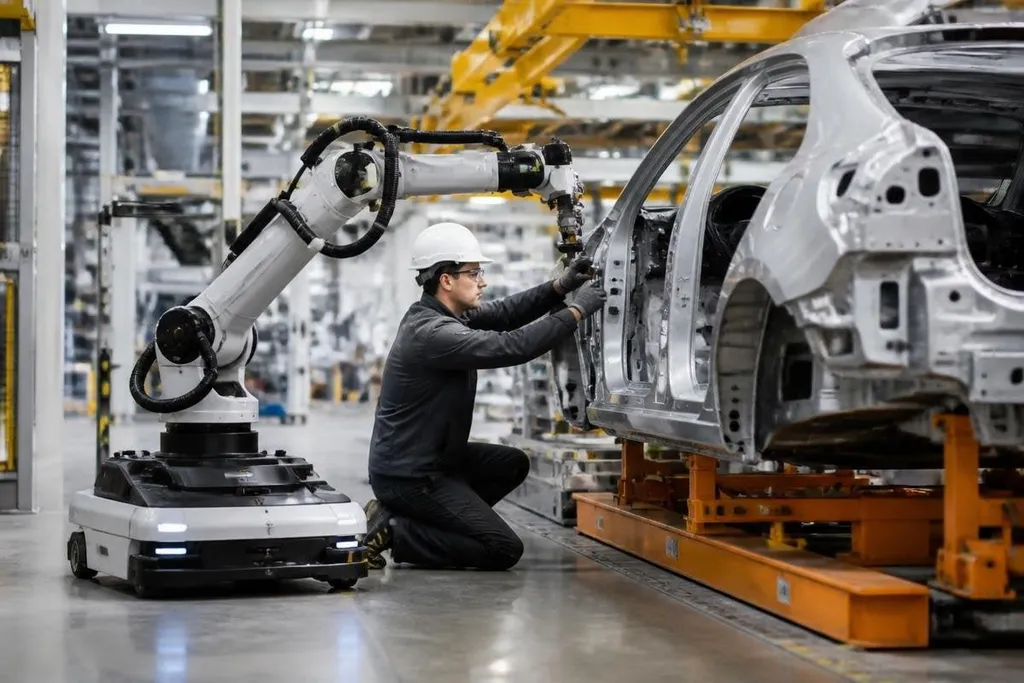
A car factory can already use robots for welding, painting, moving parts, and inspection. The harder question is what happens when robots leave fixed stations and work beside people, handle changing parts, or move through busy service areas.
The future of automotive robots will depend on jobs completed safely, not on how human a machine looks.
- Fixed arms will keep handling repeatable factory work.
- Mobile robots will need better maps, sensors, and safety rules.
- Repair shops will need machines that work across many vehicle models.
Factory work will stay the first test
Automotive plants suit robots because the work repeats, the tools stay in known places, and each step follows a set process. A robot arm can hold a body panel in the same position while another tool welds or applies sealant.
That setup removes much of the uncertainty found outside a factory. The robot does not need to guess where a part might be. Its software receives a fixed path, its sensors check the work area, and its controller sends motion commands to the motors.
The next change will come from tasks that vary. A factory may build several vehicle models on one line, with different panels, battery packs, or interior parts.
Robots will need to identify the part, select the right tool, and adjust their motion without stopping the line. This is where vision systems matter.
A camera can locate a component, while force sensing can tell the robot whether a plug is seated or a fastener has met the right resistance. Those checks help reduce damage, but the robot still needs clear limits and a safe response when the reading looks wrong.
Mobile robots will face a messier workplace
A fixed robot works inside a known reach. A mobile robot must move around people, carts, tools, doors, and parts left in the wrong place. That adds mapping, route planning, obstacle detection, and battery management to the job.
Automotive factories already use automated guided vehicles and autonomous mobile robots to move parts. The next step may be machines that collect parts from changing locations or bring tools to a technician. Their value will depend on how often they need help from a person.
A changing factory task needs more than a smooth demo; it needs a record of the robot working after the layout or part location changed. Automotive robotics coverage from Robot24.com can help you compare the machine, task, and result before you decide whether human help stays occasional or becomes part of every run.
A robot that stops for every small change can create more work than it removes. A useful system needs a clear handoff: the worker sees the fault, fixes the cause, and sends the robot back to its task without a long software session.
Battery work raises the safety stakes
Electric vehicles add battery handling to the list of factory tasks. Battery packs are heavy, costly, and built from cells that can store a large amount of energy. Robots may move packs, place modules, inspect connections, or carry damaged units to a safe area.
Those jobs need more than position control. The system must check weight, grip, temperature, collision risk, and the condition of each pack. A failed lift or dropped battery can damage equipment and put workers in danger.
The open issue is how much of this work can run without direct supervision. A controlled factory cell may support high robot use, while a repair shop with mixed vehicles and unknown battery damage needs a person at every important decision.
Repair shops will need flexible machines
Factory robots benefit from repeatable layouts. Repair shops do not have that advantage. A technician may work on different models, damaged parts, tight spaces, and vehicles that have been modified after leaving the factory.
Robots could help with inspection, lifting, sanding, paint preparation, or parts delivery. They will need compact bodies, safe force limits, and software that lets a technician change a task without rebuilding the whole system.
The price also matters. A machine that saves 20 minutes per repair may still make sense for a busy shop, but only if setup, training, service, and floor space fit the shop's budget. Public claims about future automotive robots rarely include those costs.
A practical buying check
Before a factory or repair shop orders a robot, check these points:
- Name the task: record the exact motion, load, speed, and work time.
- Count the changes: list the vehicle models, parts, tools, and layouts the robot must handle.
- Set the handoff: state when a worker takes control and how the task restarts.
- Price the full system: include grippers, sensors, software, training, service, and safety equipment.
- Test failure recovery: ask the supplier to show what happens after a blocked path, bad part, or lost sensor reading.
I'd judge the next wave of automotive robots by recovery time. A machine that finishes a varied job and returns to work after a fault will matter more than one that performs a perfect staged task.
That test will decide which robots move beyond controlled factory cells and into the mixed, changing work of real automotive production.